



Products / Machine
Air-Swept Ball Mill
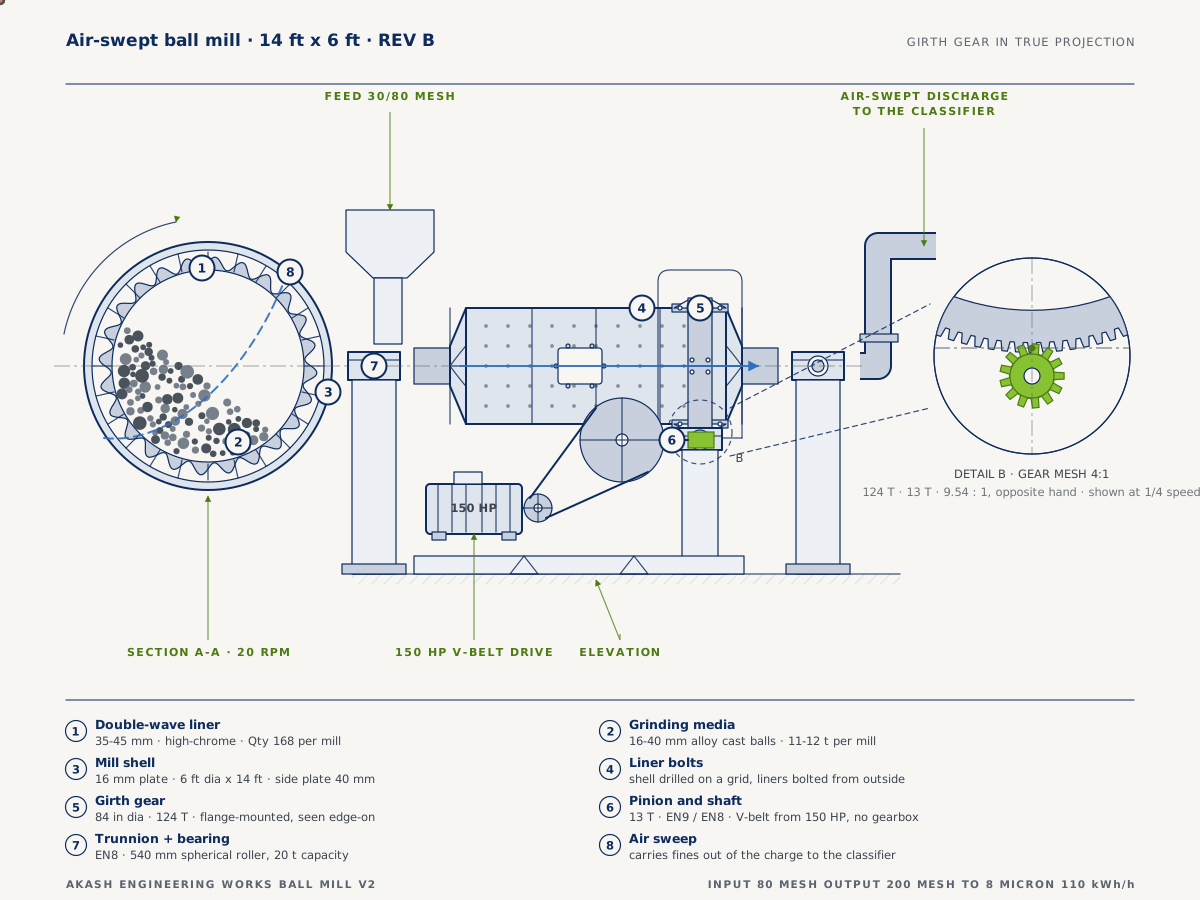
The grinding stage. A 6 ft diameter, 14 ft long shell turning at 20 RPM, charged with 11–12 tonnes of alloy-cast media, swept with air so fines leave the charge as soon as they are made.
Specification
Every figure, and where it comes from.
Values are taken from the company's own technical specification and cross-checked against its quotations. Where two documents disagree, both readings and the rule applied are stated in the row.
- Type
- Closed-circuit single-chamber air-swept ball millTechnical specification §3(b)
- Mill size
- 6 ft diameter × 14 ft lengthTechnical specification §3(d), all 8 quotations
- Mill speed
- 20 RPMTechnical specification §3(f)
- Feed size
- 30/80 meshTechnical specification §3(e)
- Output size
- 200 mesh down to 8 micronAll three brochures
- Shell thickness
- 16 mmTechnical specification §3(g)
- Side plate
- 40 mmAll quotations
- Liners
- Double wave, 35–45 mm, high-chrome steel, 168 per millTechnical specification §3(l)
- Grinding media
- Hi-chrome / alloy cast balls, 16–40 mmTechnical specification §3(m)
- Media charge
- 11–12 tonnes per millRange: quotations say 11 t, tech spec §3(m) says 12 t
- Girth gear
- 84 in dia, 124 teeth, MS, in a gear guard with dip-type lubricationTechnical specification §3(i), §3(n)
- Pinion
- EN9Technical specification §3(h), §3(o)
- Pinion shaft
- EN8Technical specification §3(h), §3(q)
- Gear guard
- MS fabricatedTechnical specification §3(p)
- Trunnion
- EN8, bolted attachmentTechnical specification §3(j)
- Trunnion bearings
- 2 off, double-row self-aligning spherical roller, 540 mm, 20 t capacityTechnical specification §3(k)
- Drive
- 150 HP, belt drive — no gearbox, no couplingTechnical specification §3(r), §3(s), §3(t)
- Power consumption
- 110 units per hourAll three brochures
The drawing
How it is built, and how it moves.
Drawn on the same drafting system as the rest of the set: five stroke weights by role, a 2 px grid, and motion derived from the machine's own kinematics rather than approximated.
How it works
The principle behind the specification.
Why air-swept, and why closed circuit
In an open circuit a particle stays in the mill until it happens to leave, which means the finest material keeps being reground long after it has reached size. Sweeping the mill with air lifts fines out of the charge as they are made, and the classifier downstream returns only the oversize. The energy that would have gone into over-grinding does not get spent.
What sets the fineness
Not the mill — the classifier. Cage speed sets the cut point, so the same mill produces 10, 15 or 20 micron product, and the throughput changes accordingly: 750, 1,200 or 1,400 kg per hour against a power draw that stays at 105–110 kWh.
The drive
A 150 HP motor drives the pinion through V-belts, and the pinion drives an 84 in, 124-tooth girth gear bolted to the shell — a 9.5 : 1 reduction with no gearbox and no coupling in the train. Fewer parts between the motor and the mill is fewer things to align and fewer things to fail.
In the works
The machine itself.
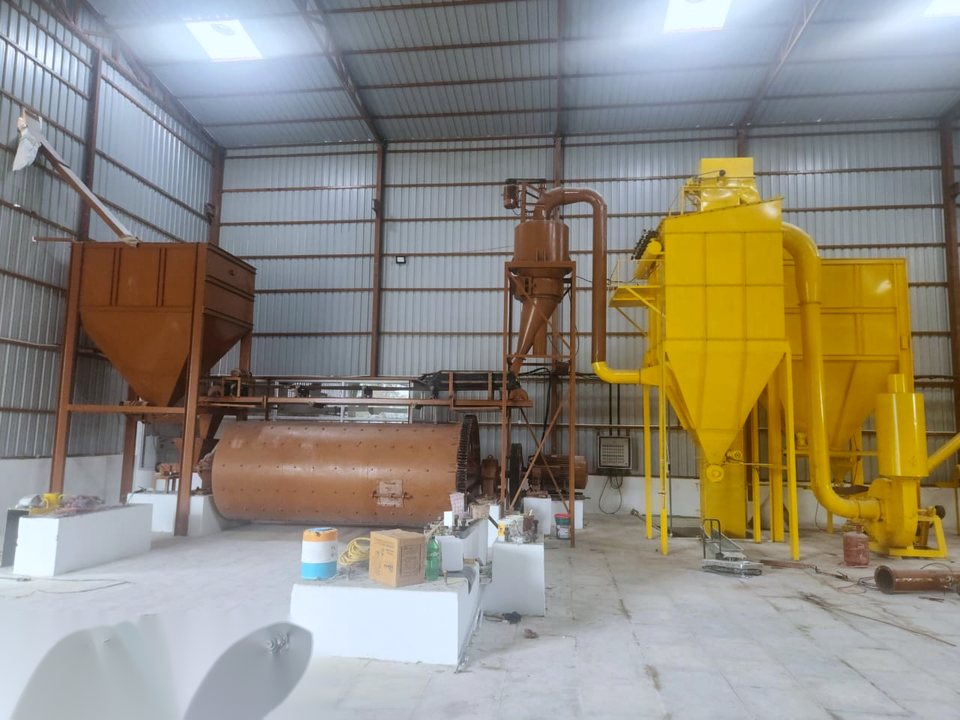
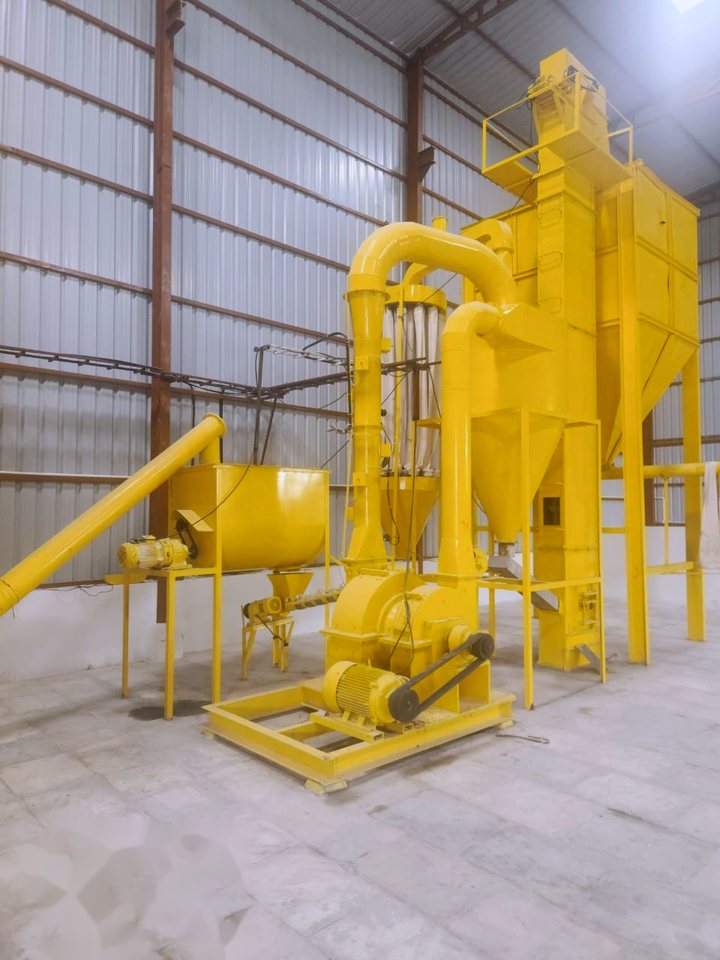
14 ft by 6 ft air-swept ball mill installed with feed hopper, cyclone and reverse-pulse-jet bag filter. Photographed at the works, retouched for exposure and white balance; nothing has been restyled or added.
Elsewhere in the line
What sits either side of it.
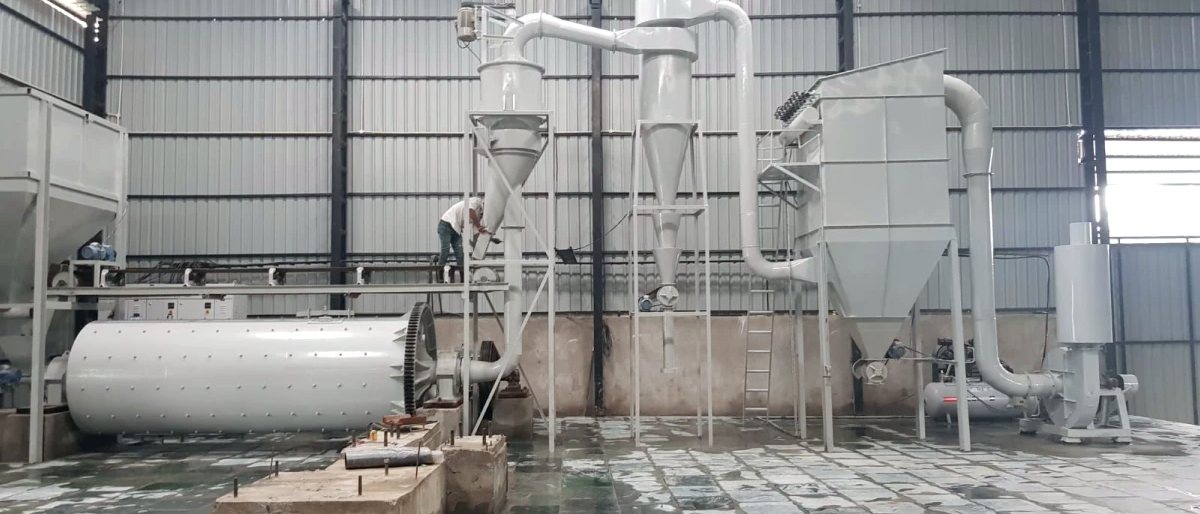
Machine · High-efficiency, 1000 mm
Dynamic Classifier
The machine that decides how fine the product is. A rotating cage inside a static guide-vane ring, with the cut point…
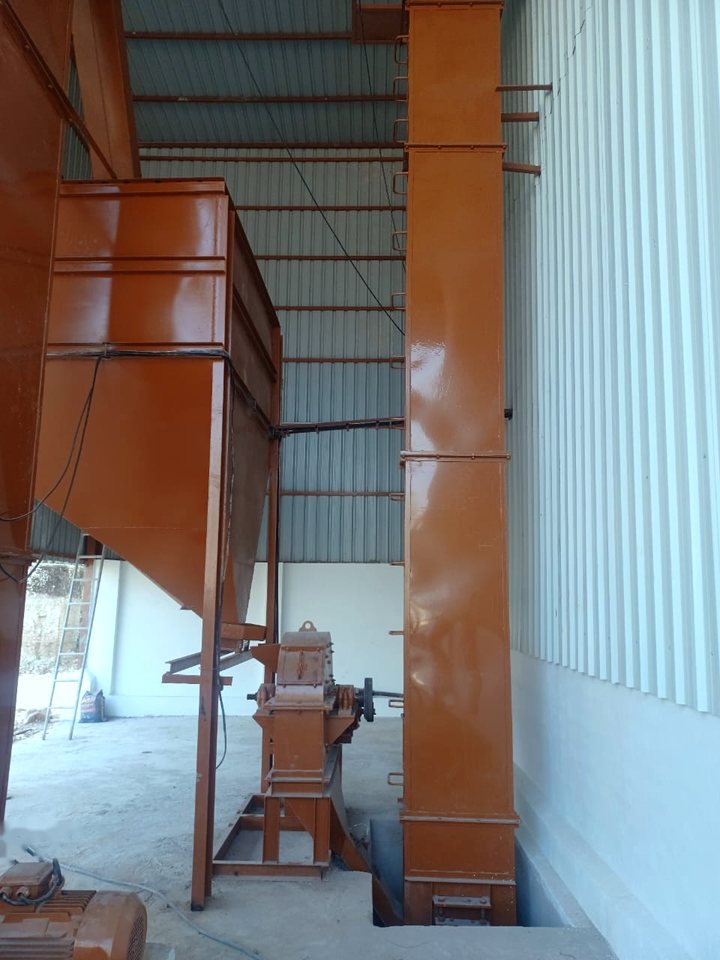
Machine · DC plant, P36
Descendicator
A beater-type disintegrator between the crusher and the mill. Required when the feed arrives as 30/80 mesh grains.
Plant · P36 · surface modification
Mineral Powder Coating Plant
Ground mineral powder treated with stearic acid so it turns hydrophobic — the difference between a filler that…
Ask about the air-swept ball mill.
Quote requests, spares enquiries and technical questions all reach the same desk. We answer with a specification, not a brochure.